
Game designers, product designers
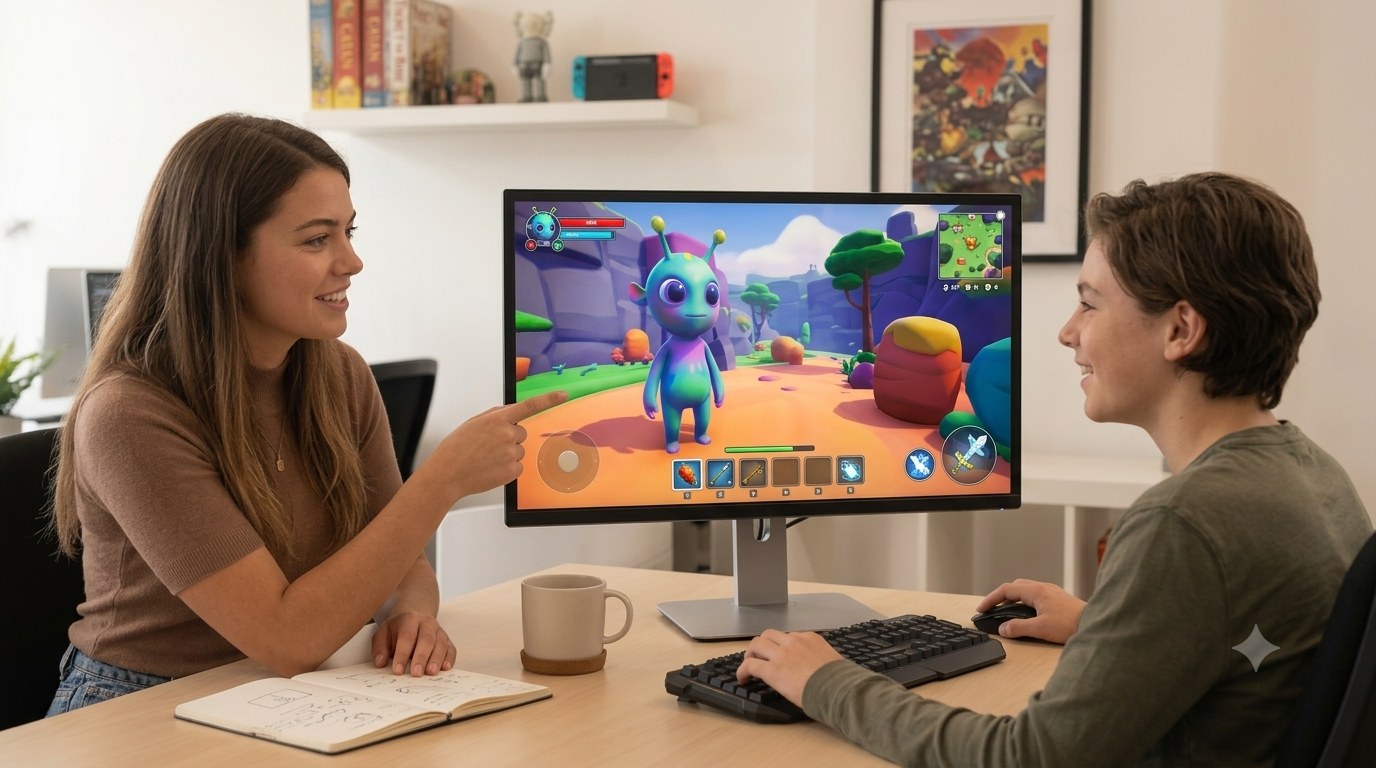
Of all the trades in the design industry, these two in particular conjure up dramatic battles of ego, huffing in meetings and passive-aggressive emails. Nothing could be further from the truth, at least where immersive technology is concerned.
Motion controllers may pack as many buttons as a standard console or PC gamepad, but the rules of the game change inside the headset. Faced with this new landscape of presence and interaction, it is better to leave the ego at the door and think about what actually matters: the users.
Same workspace, different instincts
Game designers and product designers usually share the same spaces in small studios. In fact, they can even "mutate" from one day to the next, depending on what challenges the day brings.
In larger teams they close ranks around projects like First Steps. One profile's decisions always affect the other, for better or for worse.
Game designer
Fun. Evoking surprise. Generating excitement and repeat play. Basically, making the player wear out the Start button to begin another round.
What they handle: rules, mechanics, rewards, innovative ideas, difficulty. Take the jump in Super Mario Bros. Behind that jump lie countless tests to make it exactly what it is.
Where they meet the product designer: VR experiences still have plenty of basics left to polish or standardize. Something as simple as picking up an object, and how that object responds, can draw on the ways of thinking inherent to each profile. The game designer makes sure the interaction is flawless on a technical level and that it fits the world around it.
Product designer
The link between the creative team and the product team. Speaks both languages.
What they handle: making sure the user's experience of reaching a goal is as good as it gets. Closer contact with strategy, conversion and marketing profiles. Responsible for meeting the requirements of publishing platforms (accessibility, comfort, and the rest).
Where they meet the game designer: are Oculus's First Steps games or tutorials? Teaching motion controllers to a user who is still marveling at the 3D space around them was a challenge solved with a game design mechanic (interacting with a character instead of, say, floating panels) and a product design one: duration. Barely five minutes, the exact window before the clumsiness of first contact with VR turns into abandonment.
“The idea of the wind whispering through the trees to tell the user which way to go is great, but… can we also put an arrow on the ground?”
Neither one gets to say “because I said so”
Effective communication is absolutely necessary when these two interact. Both roles matter equally. There is no because I said so, and no this stays as it is because there's no way to do it the way you want.
In these professional arguments there is always a middle ground, even when it gets clouded by a possible battle of egos. Being a good game designer means redirecting creativity to solve a usability problem. Trusting the player's instinct without ever letting go of their hand is a great responsibility of the product designer.
So far, that is the ideal scenario for collaboration: parallel and productive.
Where it goes wrong
Without the right planning or goals, though, these profiles can generate real friction. If flaws in the mechanics get dragged along from the prototype phase, the product designer may well consider fixing them crucial. And that is when the crunch hours arrive, and the frustration with them. Something as easy to prevent as handing the documentation to every profile from the very beginning.
But what if the product designer's request answers to criteria beyond usability? Who decides whether it is reasonable to spend four days modifying shaders because the CEO of the company advertising inside the game says that a color "doesn't look quite the same to the naked eye"?
“How many hours have I spent trying to recreate that same Streets of Rage punch feel in our boxing game? … What day is it today?”
Cohesion beats being right
Experience tells us that the best digital products come out of cohesive teams that know when to give ground, even after clashing along the way.
Sharing goals, building complicity and passing on confidence is the perfect breeding ground for both profiles to give the best of themselves.
Get in touch
with Celia
Meet Celia. She's the heart of KA Studio. Technology connoisseur. Gamer. Designer. User centered.
She builds the right team for every project.
No two get the same lineup.